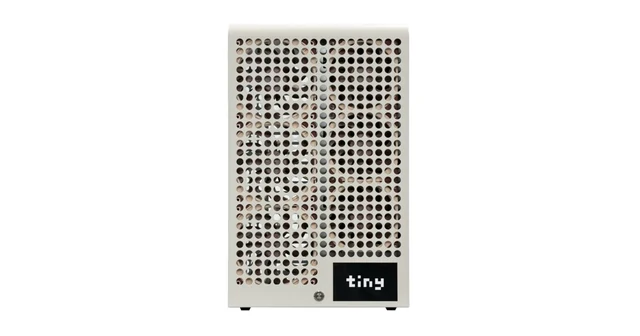
Tiny Corp builds tinygrad, an open-source neural-network framework and tinybox AI-compute hardware; it was founded by George Hotz
Funding and status
- Latest round:
- $5.1 million venture/early-VC round, May 2023; lead investors not reported in the cited sources
- Total raised:
- $5.1 million disclosed through May 2023; no later closed financing was found
- Reported talks:
- March 2026: publicly reported fundraising discussions for $20 million at a $200 million valuation; the proposal was associated with buying an $11.5 million Oregon building and expanding compute infrastructure, and was not reported as closed
No open roles right nowKernels and compilers
Similar companies
 doubleAIRamat Gan, Israel · $1B post-money valuation · $225M raised—
Founded in 2023 by Amnon Shashua, Shai Shalev-Shwartz, and other former doctoral students, doubleAI builds Artificial Expert Intelligence focused initially on optimizing low-level code and solving complex scientific and engineering problems

 InfinitySan Francisco · $100M post-money valuation · $15M raised—
Infinity builds AI-generated software—including kernels, compilers, debuggers and profilers—that makes non-NVIDIA AI chips ready for inference; it was founded by Jeremy Nixon, a former Google Brain researcher and AGI House co-founder
 BoolSiBoston, Massachusetts · $8M raised—
BoolSi builds a compiler platform that turns software hotspots—such as C/C++ functions—into custom, verified hardware accelerators; it was founded by Mihailo Isakov, an AI researcher with a PhD in chip design

 DaisytunerDarmstadt, Germany · $8M raised—
Daisytuner builds a self-learning AI compiler and Daisyflow inference platform that optimize AI models for different chips; it was founded in 2024 by Lukas Trümper and Adrian Schmitz
 —
Magni builds near-silicon inference optimization using agent swarms, cross-vendor KV-cache codecs (AllQuant), and GPU megakernels (Magni VM)
 MakoraNew York City · $9M raised—
Makora builds automated performance-engineering software that optimizes and deploys high-performance GPU code across hardware for AI workloads; it was co-founded by Waleed Atallah, Mohamed Abdelfattah, and Lukasz Dudziak